
June 29, 2026
Why Calgary Winters Kill More Cars Than Crashes Do (And the 4 Signs Yours Is Next)
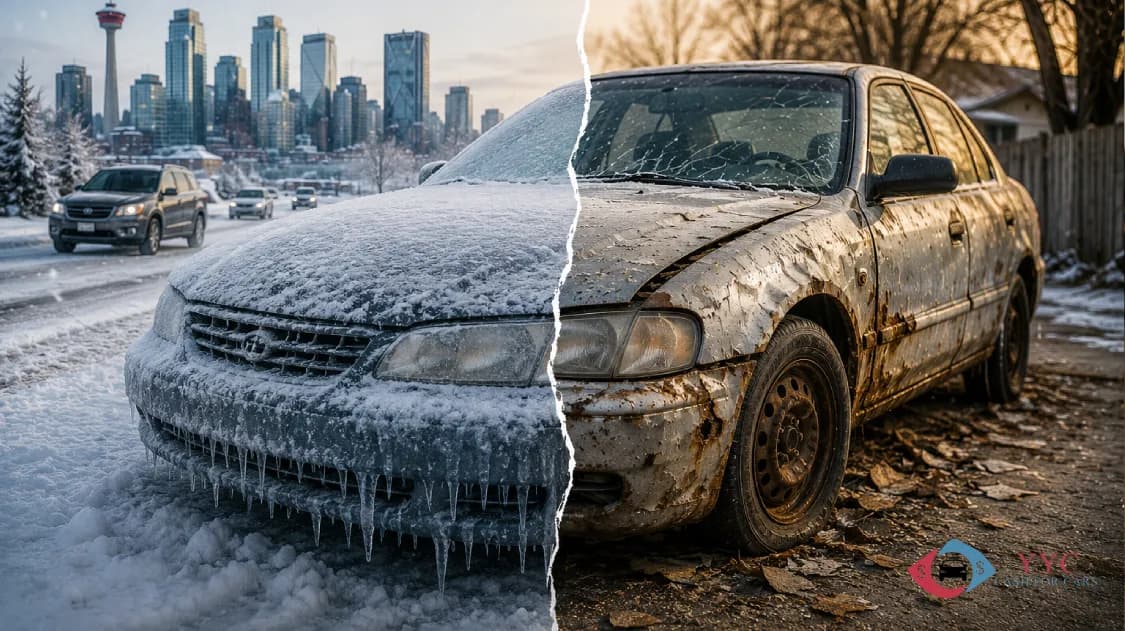
Walk into any tow yard in northeast Calgary on a Tuesday morning in February. The cars sitting there with frozen windows and tarps over the hoods? Almost none of them got into accidents.
They just died.
Engines that wouldn't turn over one too many times. Transmissions that gave up halfway through the morning commute. Frames so rusted the inspection guy couldn't even sign off without laughing. Crashes get all the attention because they're loud and they make the news. But the real killer in this city is the weather, and it works on your car every day from November to April whether you notice or not.
What Calgary actually does to your car
You can't really compare Calgary to other Canadian cities, not even other prairie ones. It's a weird climate and it punishes vehicles in three ways at the same time.
First, the cold. Below about -25, your engine oil basically turns into syrup. The starter is asking your crankshaft to spin through that gunk while the battery is sitting at maybe 60% of its summer cranking power. Mechanics around town will tell you a single cold start at -30 does about as much damage as a 500-kilometre highway run. Do that 40 or 50 times a winter and you can do the math.
Second, the brine. Calgary doesn't just salt the roads anymore. They spray that calcium chloride mixture that sticks to everything. It saves lives, no question. But it also coats the bottom of your car with corrosive liquid that finds every weld, every chip in the paint, every spot where the undercoating wore off three years ago. Frame rust in Calgary doesn't happen because you neglected your car. It happens because you drove it.
Third, and this is the part Edmonton doesn't really deal with, chinooks. A Calgary car will go from -28 overnight to +5 by lunchtime. Water that got in around the windshield, into the rocker seams, under the door panels — it freezes, expands, melts, repeats. Over a season your car flexes hundreds of times in places that aren't designed to flex. By spring, every one of those tiny stress points is a rust starter.
No other Canadian city does all three. Calgary cars age in dog years.
The 4 signs your car is on the way out
Most people don't realize their vehicle is finished until the repair quote arrives. By then the decision's already made for you. Here are the four signs to watch for so it doesn't sneak up.
1. You can see through the frame
This is the one nobody checks. Get on the ground next to your car. Look at the rocker panels (the metal strip below the doors), the rear quarters, and the frame rails near the back wheels. If there are holes, or if you push on it and the metal flexes like cardboard, you're done.
It doesn't matter how nice the paint looks. Once frame rust eats through structural metal, an out-of-province inspection will fail the car and the welding bill to fix it will be more than the car's worth. Probably way more. I've seen quotes in Calgary north of $4,000 just to make a 12-year-old Civic legal again.
2. It takes more than five seconds to start
A car that's healthy should fire up within about two seconds even at -30. If yours is cranking and cranking and finally catching with a clatter, that's not normal and it's not just "old car noises."
Could be the battery. Could be the oil pump giving up. Could be compression dropping in a cylinder. Could be variable valve timing components wearing out. Any one of these by itself? Fixable. Two or three of them showing up the same winter usually means the engine is on borrowed time.
3. The transmission pauses before it shifts
Try this in the morning. Cold engine, drop it into Drive, ease onto the gas. If there's a half-second hesitation, or a thud when it finally engages, or that floaty slipping feeling as it works through the gears, your transmission fluid is breaking down and the friction plates have probably already taken damage.
Calgary's hard on transmissions specifically because the fluid spends so much time below its proper operating temperature. A rebuild around town runs three and a half to six grand depending on the car. Stick that into a vehicle worth four grand and you've just lit money on fire.
4. You've put more than half the car's value into repairs this past year
This is the one nobody wants to do honestly. Pull out your receipts. Tires, brakes, alignments, exhaust work, that weird electrical thing in October, the tow last month. Add it all up.
Now look at what your car would actually sell for on AutoTrader or Kijiji this week. Not the dealer's trade-in number. What a real person would pay you for it tomorrow.
If your year of repairs is more than half that number, you're not driving a car anymore. You're funding a charity for it. And the next big bill is coming, because cars don't suddenly start repairing themselves better just because you've already paid a lot.
So what do you actually do about it
When you spot two or more of these signs, the question isn't whether to scrap it. It's just timing.
Stop putting money in. Safety stuff like brakes and tires, sure. Anything else? You're throwing it away.
Get a real number for what the car's worth. Canadian Black Book gives you a baseline. Recent listings on AutoTrader tell you what the market actually does.
Call around for scrap quotes. Three minimum. Calgary wreckers will quote wildly different numbers on the exact same car. Sometimes a $400 difference for the same vehicle on the same day. A good buyer also tows for free, so don't pay for that either.
Don't forget the small stuff. Winter tires bolted on the rims, a battery you replaced last spring, the catalytic converter. These often add a few hundred bucks if you negotiate them in or pull them off and sell separately.
The bottom line
Calgary doesn't kill cars with one big hit. It does it slowly. Ten thousand cold starts. Ten thousand kilometres of brine. Ten thousand freeze-thaw cycles. Spread out over a decade until one morning the car just doesn't start, and you're standing in the driveway trying to figure out how it got there.
Crashes make headlines. Winter takes the cars.
The people who catch it early walk away with money in hand and a better vehicle by spring. The ones who don't are the ones standing in some tow yard in February holding a repair estimate they already knew the answer to.